

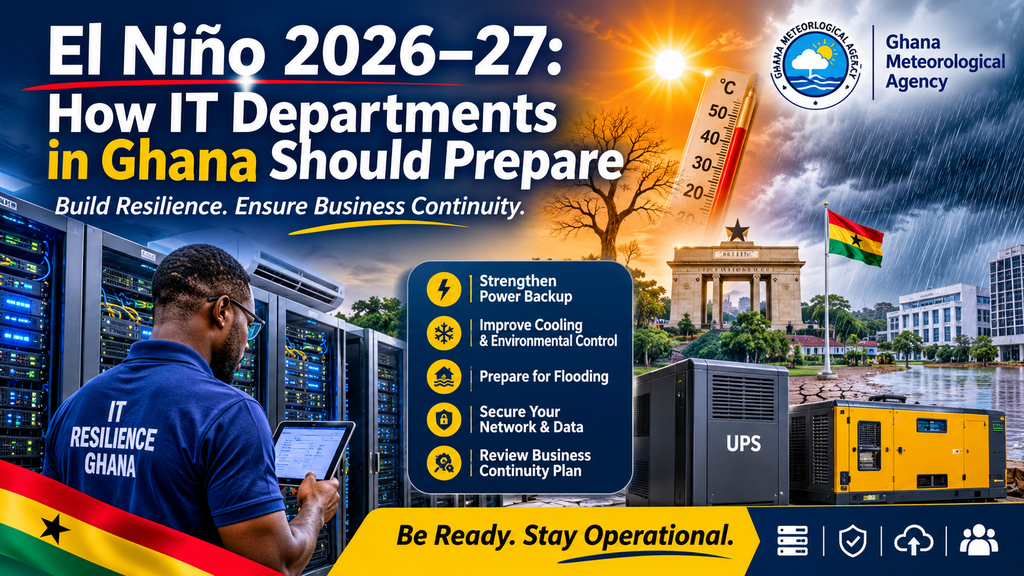
Power outages, extreme heat, flooding, water shortages and infrastructure disruptions could test the resilience of organisations across Ghana. Is your IT department prepared?
Climate Risk Is Also an IT Risk
When we talk about El Niño, the conversation often revolves around agriculture, rainfall patterns, food security, water resources and electricity generation.
But there is another important dimension that organisations in Ghana must not overlook: the impact of changing climate conditions on their IT infrastructure, technical operations and business continuity.
According to an October 2026 technical brief published by the Ghana Meteorological Agency (GMet), Ghana is facing a developing very strong El Niño event expected to persist into early 2027.
The report highlights several potential risks, including hotter and drier conditions, bushfires, water stress, Harmattan dust, heat-related health concerns and the possibility of localised flooding. It also warns that the 2027 rainy seasons remain uncertain, with the possibility of either delayed rainfall or above-normal rainfall and flooding.
These developments should concern every organisation that depends on technology to deliver its services.
Think about it.
What happens when your organisation’s server room becomes excessively hot? What happens when a prolonged power interruption affects your network infrastructure? What happens when flooding damages your office’s network equipment, fibre connections or electrical installations?
What happens when your organisation loses access to its critical business applications because its infrastructure was not prepared for environmental disruptions?
These are not merely technical questions. They are business continuity questions.
For this reason, IT and Technical departments across Ghana should begin reviewing their infrastructure resilience and disaster preparedness strategies now.
Let’s examine the key areas that deserve attention.
1. Understand the Climate Risks Facing Your Organisation
The first step towards preparedness is understanding the risks.
GMet’s technical brief identifies several periods of concern:
- November 2026 — April 2027: Increased risk of hotter and drier conditions, bushfires, water stress and dust.
- December 2026 — January 2027: Very strong El Niño conditions are most likely to be near their peak.
- February — April 2027: Increased heat stress, particularly in northern Ghana.
- May — July 2027: Uncertainty surrounding rainfall patterns, including the possibility of delayed or weak rains or above-normal rainfall if La Niña develops.
- August — October 2027: Important Volta Basin inflow period, with implications for future hydropower generation and downstream flood preparedness.
GMet also emphasises that localised heavy rainfall and flooding remain possible even when seasonal rainfall is expected to be below normal.
This is particularly important.
Organisations should not prepare exclusively for drought or heat. They must prepare for both extremes.
IT departments should conduct an environmental risk assessment covering:
- Server rooms and data centres.
- Network operation centres.
- Electrical distribution systems.
- Backup power installations.
- Fibre-optic and telecommunications infrastructure.
- CCTV and physical security systems.
- Broadcast and transmission equipment.
- Office buildings and equipment storage facilities.
The objective is to identify which technology assets are most vulnerable and what operational consequences could follow if they fail.
2. Review Server Room and Data Centre Cooling Systems
One of the most important preparations concerns cooling.
Servers, network switches, storage systems, routers and other electronic equipment generate heat during operation. These devices require suitable environmental conditions to operate reliably.
When cooling systems become inefficient or fail, equipment temperatures can rise beyond acceptable operating limits.
This can result in:
- Hardware instability.
- Unexpected server shutdowns.
- Reduced equipment lifespan.
- Storage and network equipment failures.
- Application downtime.
- Data corruption in certain failure scenarios.
With GMet projecting warmer-than-average conditions across much of Ghana, organisations should pay particular attention to their server room cooling arrangements.
Recommended actions:
- Service all server room air-conditioning systems before the peak heat period.
- Where business-critical operations justify it, provide redundant cooling capacity.
- Install temperature and humidity monitoring sensors.
- Configure automatic alerts when environmental readings exceed equipment-specific thresholds.
- Check airflow management, including cold and hot aisle arrangements where applicable.
- Inspect ventilation systems and ensure equipment air intakes are not obstructed.
- Establish an emergency response procedure for cooling failures.
For organisations operating larger data centres, environmental monitoring should be integrated into their Building Management Systems (BMS) or Data Centre Infrastructure Management (DCIM) platforms where available.
Do not wait for a server to shut down before discovering that your cooling system is inadequate.

3. Strengthen Power Backup and Electrical Infrastructure
Electricity reliability is another major concern.
GMet’s report highlights the relationship between rainfall variability, Lake Volta inflows and hydropower generation.
It explains that the El Niño-sensitive period for Ghana’s hydropower system is primarily the 2027 inflow season, with implications for electricity generation in 2028.
The report does not predict that El Niño will automatically cause power rationing during the 2026/27 dry season. Electricity generation during that period depends mainly on existing reservoir storage.
Nevertheless, organisations should review their power resilience arrangements.
A power interruption can affect almost every aspect of modern business operations.
Consider a financial institution processing transactions, a hospital managing patient records, a television station transmitting live programmes or a company operating cloud-connected business applications.
Even a short interruption can have significant consequences.
Recommended actions:
- Inspect and service Uninterruptible Power Supply (UPS) systems.
- Test generator performance under realistic load conditions.
- Check battery health and replacement schedules.
- Ensure automatic transfer switches (ATS) operate correctly.
- Verify that critical network and server equipment is connected to backup power.
- Review fuel availability and replenishment arrangements.
- Establish a power prioritisation plan for critical equipment.
- Consider alternative power sources, including solar and battery storage, where technically and financially viable.
IT departments should also document how long critical infrastructure can operate using available backup power.
For example, knowing that your UPS provides 15 minutes of runtime while your generator requires 30 minutes to become operational is an important operational risk.
The objective is to eliminate gaps between the failure of the primary power source and the availability of backup power.

4. Protect Infrastructure Against Flooding and Heavy Rainfall
One of the most important lessons from Ghana’s recent climate experiences is that drought and flooding can both present serious risks.
The GMet report documents the severe flooding experienced in Greater Accra in June 2026. It also highlights the 2023 Akosombo and Kpong dam spillage, which affected downstream communities.
Even during periods when below-normal rainfall is expected, intense localised rainfall can still occur.
Organisations must therefore assess the physical location of their critical IT infrastructure.
Imagine a server room located on the ground floor of an office building in a flood-prone area.
A single flooding incident could damage:
- Servers and storage devices.
- Network switches and routers.
- Fibre termination equipment.
- UPS systems and batteries.
- Electrical distribution panels.
- CCTV recording systems.
- Access control infrastructure.
Recommended actions:
- Avoid locating critical IT equipment in basements or flood-prone sections of buildings where possible.
- Elevate critical equipment above potential water entry levels.
- Inspect roof drainage, gutters and water drainage systems.
- Protect external network cabinets and telecommunications equipment against water ingress.
- Ensure electrical installations have appropriate protection.
- Identify alternative equipment locations for emergency relocation.
- Maintain off-site backups and disaster recovery arrangements.
Organisations with critical operations should also consider geographically separate disaster recovery infrastructure.
A backup server located in another room within the same flood-prone building may not provide meaningful protection against a major physical disaster.

5. Protect Telecommunications and Network Infrastructure
Modern organisations depend heavily on internet connectivity and internal networks.
From cloud-based applications and email systems to enterprise resource planning (ERP), VoIP telephony, CCTV and remote working platforms, network availability is central to business operations.
However, telecommunications infrastructure can also be affected by environmental conditions.
Flooding can damage underground ducts, fibre-optic connections and telecommunications cabinets. Power interruptions can affect network equipment and telecommunications facilities. Bushfires can threaten exposed infrastructure in vulnerable locations.
Recommended actions:
- Review the physical routes of critical fibre-optic connections.
- Identify single points of failure within the network.
- Consider dual internet service providers where business requirements justify the investment.
- Use different physical routes for redundant connectivity where possible.
- Ensure routers, firewalls and switches are connected to protected power supplies.
- Back up network device configurations.
- Monitor network availability and performance continuously.
- Establish alternative communication channels for emergencies.
For organisations with multiple branches, network redundancy should be included in their disaster recovery strategy.
Having two internet subscriptions does not necessarily provide redundancy if both connections depend on the same physical infrastructure.

6. Strengthen Data Backup and Disaster Recovery
Climate-related disruptions can result in physical equipment damage, prolonged downtime and loss of access to critical information systems.
This makes data protection and disaster recovery planning particularly important.
Every organisation should understand that having a backup is not the same as having a working disaster recovery strategy.
A backup that cannot be restored when needed offers little practical protection.
IT departments should review their backup policies and ensure that critical business information is protected.
Recommended actions:
- Maintain regular automated backups.
- Keep at least one backup copy off-site.
- Consider immutable or offline backups to protect against ransomware and destructive incidents.
- Encrypt sensitive backup data.
- Test restoration procedures regularly.
- Document Recovery Time Objectives (RTOs).
- Define Recovery Point Objectives (RPOs).
- Maintain documented disaster recovery procedures.
- Identify alternative systems and locations for critical business operations.
The 3–2–1 backup strategy remains a useful starting point:
- Maintain three copies of important data.
- Store them on two different types of storage media.
- Keep one copy off-site.
For critical organisations, the strategy should also account for ransomware, cyberattacks and the possibility that backup infrastructure may be affected by the same physical incident as production systems.

7. Prepare for Harmattan Dust and Environmental Conditions
GMet identifies Harmattan conditions, typically extending from late November to March, as another important consideration.
Dry northeasterly winds, reduced humidity and periodic dust haze can affect air quality and visibility, particularly across northern and middle Ghana.
For IT and Technical departments, dust management deserves attention.
Dust accumulation in electronic equipment can obstruct airflow, contribute to overheating and increase maintenance requirements.
This is particularly relevant to:
- Server cooling filters.
- Network cabinets.
- Broadcast equipment.
- Computer workstations.
- UPS ventilation systems.
- Outdoor telecommunications installations.
- Security and surveillance equipment.
Recommended actions:
- Increase inspection and cleaning schedules for critical equipment.
- Ensure server rooms have appropriate filtration and controlled airflow.
- Inspect cooling filters regularly.
- Keep equipment rooms properly sealed against excessive dust ingress.
- Use appropriate cleaning procedures and qualified technicians.
- Inspect outdoor equipment enclosures and protective seals.
For broadcasting organisations, additional attention should be given to satellite receiving equipment, antenna systems, outdoor transmission infrastructure and associated electrical connections.
Environmental maintenance should be part of the preventive maintenance schedule rather than something undertaken only after equipment develops a fault.

8. Establish an IT and Technical Business Continuity Plan
One of the biggest mistakes organisations make is treating disaster recovery as an IT department responsibility alone.
Business continuity requires coordination between IT, Technical Operations, Administration, Facilities Management, Human Resources, Security and Executive Management.
A climate-related incident can affect several departments simultaneously.
For example, a major power interruption could affect:
- The organisation’s servers.
- Internet connectivity.
- Access control systems.
- CCTV monitoring.
- Telephone systems.
- Production equipment.
- Employee access to business applications.
IT departments should therefore work with management to develop or update a Business Continuity Plan (BCP).
The plan should identify:
Critical business services: Which services must remain operational during a disruption?
Critical infrastructure: Which servers, applications, network devices and technical systems support those services?
Recovery priorities: Which systems should be restored first?
Alternative working arrangements: Can employees work remotely or from another location?
Communication procedures: How will employees, customers, suppliers and stakeholders receive updates?
Emergency contacts: Who is responsible for making technical and management decisions during an incident?
Recovery procedures: How will normal operations be restored?
The plan should be tested through practical exercises, not simply stored as a document that nobody reads.
9. Introduce Environmental Monitoring and Early-Warning Systems
One of the strongest recommendations in GMet’s report is the need for continuous climate monitoring, improved impact-based early warning and location-specific advisories.
The report also recommends the use of the Common Alerting Protocol (CAP) so broadcasters, mobile networks and district assemblies can communicate warnings consistently.
Organisations can apply the same principle internally.
Instead of waiting for an incident to occur, IT and Technical departments should establish monitoring systems that identify potential problems early.
Examples include:

Monitoring platforms can be configured to send alerts through email, SMS or other approved communication channels.
Organisations should also establish escalation procedures so that alerts reach the right personnel quickly.
Where appropriate, technical teams should subscribe to GMet weather advisories and incorporate relevant warnings into operational planning.
10. Develop an Emergency Response and Maintenance Schedule
Preparedness requires more than purchasing additional equipment.
It requires knowing who will respond, what actions they must take and how quickly they must take them.
IT and Technical departments should establish a preventive maintenance and emergency response schedule covering the November 2026 to April 2027 peak dry-season risk period, while maintaining preparedness for flooding and the uncertain 2027 rainy seasons.
A practical maintenance programme should include:
- UPS inspection and battery testing.
- Generator servicing and load testing.
- Air-conditioning maintenance.
- Server room environmental inspections.
- Network infrastructure assessments.
- Backup and recovery testing.
- Electrical installation inspections.
- CCTV and physical security testing.
- Emergency communication drills.
- Review of disaster recovery documentation.
Every activity should have an assigned responsible person, a completion deadline and a record of findings.
Organisations should also conduct tabletop exercises and practical simulations to test their response to power failures, server room overheating, flooding and telecommunications outages.
11. Prepare a Dedicated Climate-Resilience Budget
Preparedness requires investment.
Management should work with IT and Technical departments to identify the resources required to improve infrastructure resilience.
The budget should consider:
- UPS replacement and additional battery capacity.
- Generator servicing and fuel arrangements.
- Server room cooling improvements.
- Environmental monitoring sensors.
- Network redundancy.
- Off-site backup storage.
- Disaster recovery infrastructure.
- Flood protection and equipment relocation.
- Preventive maintenance.
- Emergency response training.
Not every organisation needs an expensive data centre or a sophisticated disaster recovery facility.
However, every organisation should understand the financial and operational consequences of losing its critical technology infrastructure.
A small investment in preventive maintenance and monitoring may prevent a much more expensive operational failure.
The key is to prioritise investments according to business impact and risk exposure.
12. A Practical El Niño Preparedness Checklist for IT and Technical Departments
Before the peak risk period, every organisation should be able to answer the following questions.
Power and electrical infrastructure
- Have all UPS systems been tested?
- Are generators serviced and operational?
- Are backup power arrangements sufficient for critical equipment?
- Have fuel and battery replacement arrangements been reviewed?
Server rooms and data centres
- Are cooling systems serviced?
- Are temperature and humidity monitoring systems operational?
- Is critical equipment protected against excessive heat and dust?
- Are environmental alerts configured?
Network and telecommunications
- Are critical network devices protected by backup power?
- Are alternative internet connections available where necessary?
- Have single points of failure been identified?
- Are network configurations backed up?
Data protection
- Are automated backups running?
- Is an off-site backup available?
- Have restoration procedures been tested?
- Are RTOs and RPOs documented?
Flood and physical protection
- Are critical IT assets located outside identified flood-prone areas?
- Are drainage and roof systems inspected?
- Are external cabinets and network installations protected?
- Is an emergency equipment relocation plan available?
Business continuity
- Is there an updated Business Continuity Plan?
- Is there an approved Disaster Recovery Plan?
- Are emergency contacts available?
- Have incident response procedures been tested?
- Does management understand the recovery priorities?
Conclusion: Do Not Wait for a Climate Emergency to Test Your Infrastructure
Ghana’s developing El Niño event should encourage organisations to rethink how they approach technology infrastructure, operational resilience and business continuity.
The lesson from GMet’s technical assessment is not that every organisation should expect a disaster. Rather, it is that climate-related risks are uncertain, can vary significantly across locations and may affect several critical sectors simultaneously.
For IT and Technical departments, the responsibility is clear: identify vulnerabilities, strengthen infrastructure, improve monitoring, test recovery arrangements and work with management to ensure that the organisation can continue operating during unexpected disruptions.
Technology infrastructure is no longer simply about installing computers, configuring networks and maintaining servers.
It is about ensuring that the organisation remains operational when conditions become challenging.
Whether you manage a hospital, bank, television station, educational institution, manufacturing company, government agency or small business, your organisation’s technology infrastructure must be resilient.
The best time to prepare your IT infrastructure for a climate-related disruption is before it happens.
Do not wait for a power failure, an overheated server room or a flooded equipment room to reveal weaknesses that could have been addressed months earlier.
Preparedness is not an emergency response. It is a management responsibility.
This article draws on the Ghana Meteorological Agency’s technical brief:
The Developing Very Strong El Niño Event (2026–27): Implications for Ghana and Recommended National Preparedness Measures.
The report was published in October 2026 and revised following the GMet Governing Board Scientific Review of 27 October 2026.
I encourage readers, particularly business leaders, IT professionals, technical managers and policymakers, to download and read the complete report.
It provides a more comprehensive assessment of the climate outlook, historical evidence, regional vulnerabilities and national preparedness recommendations.
Download the full Ghana Meteorological Agency report below.
Preparedness begins with information. Resilience begins with action.
Next: Python Automation 2026: From Simple Scripts to Real-World Workflows — Introducing the Series
Leave a Reply